The Veil Features
Universe
Overview The Veil & The Void Factions Species Key Locations History & Timeline Classes & Roles
Lore
Key Figures Culture & Society Interstellar Travel The Null Protocol The First Silence ✦
Rules Join Beta

Culture &
Society

Six species. Dozens of worlds. One shared language built out of necessity — and a thousand traditions they refuse to give up.

01

Meridian — The Common Tongue

Nobody designed Meridian. It grew. Over two hundred years of trade across the Drift lanes, fragments of six languages fused into something that isn't native to anyone and belongs to everyone.

The name comes from the Arion word meridar — meaning roughly "the place where things meet." It was a joke at first; Arion traders called the pidgin they used at crossroads stations the "meridar tongue." By the time the Sovereignty tried to enforce its own standardized language — High Solaran — Meridian was already too embedded to displace. The Sovereignty still teaches High Solaran in its academies. Everyone learns Meridian in the streets.

It has irregular grammar, borrowed phonology from all six species, and no written standard — though three competing written forms exist and speakers of each claim the others are wrong. In practice, context does most of the grammatical work. Tone does the rest. Insults are, for historical reasons, borrowed primarily from Vrask.
Vel'tara Lit. "open current" — used as a greeting between strangers, particularly on shared vessels or at way-stations. Carries an implication of goodwill and non-hostility. Roughly: "safe passage to you."
Keth'sol From Keth engineering shorthand — lit. "problem acknowledged, solution incoming." Used colloquially to mean "understood, I'll handle it" or more sarcastically, "yes, obviously."
Drak'amara Vrask origin — lit. "worthy adversary." Used as high praise between combatants, but also in negotiation: telling someone they're drak'amara means you respect them enough to deal honestly.
Sileth'vor Sylari — lit. "the light that remembers." Used when someone does something that will outlast them. A ship named for a fallen captain is sileth'vor. A song written for a dead child is sileth'vor.
02

The Drift Mark

The Sovereignty Credit is the official currency of the galaxy's largest government. Outer system traders stopped accepting it somewhere around the second generation of lane buoy deployment, when it became clear that monetary policy set in Solara Prime did not reflect realities in the Drift lanes.

The Drift Mark emerged from trader culture — originally a reputation system encoded into carved alloy discs that served as transaction records. Over generations it standardized into three physical forms and one digital form, none of which require a centralized authority to verify.

Pressed Alloy Discs The oldest form. Still the most trusted in Vrask-majority ports, where physical objects carry weight that digital records don't. High-denomination discs are engraved with transaction history on the rim.
Encoded Crystal Shards Keth-manufactured. A resonance pattern encoded into synthetic crystal acts as a unique, uncopyable value token. Preferred by information traders and anyone who needs discretion — there's no visual denomination indicator, just a reader and a value.
Digital Ledger Tokens A distributed ledger maintained by the Free Trader network, not any government. Fast, auditable, requires only a Drift-lane relay connection. The Sovereignty has tried to ban it twice. Both times, trade volumes dropped enough that they reversed course within a season.

The Sovereignty Credit can't be enforced past the lane buoys because the enforcement apparatus — Sovereignty financial inspectors, trade compliance officers, seizure authority — doesn't exist in outer systems. The Sovereignty knows this. It is one of several structural problems they have decided to address by not acknowledging.

03

Food & Gathering

In a galaxy of six species with incompatible physiologies, dietary requirements, and sensory ranges, food became one of the primary sites of cultural negotiation.

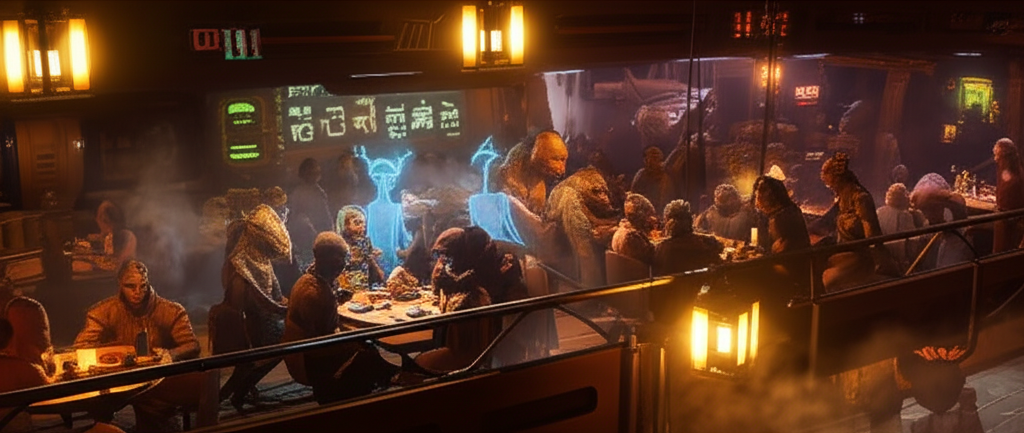
The cantina is the central institution of interstellar life — not restaurants, not bars, not community halls, but specifically the cantina: a multi-species establishment where dietary incompatibilities are managed by dedicated cross-species kitchen staff who have mastered the art of making something everyone at the table can consume without incident. A good cantina cook is one of the most universally respected professionals in the outer systems.

Among Vrask, cooking for someone is a formal act of trust — the preparation and sharing of food is embedded in Vrask honor culture as an acknowledgment of mutual non-hostility. Vrask traders who feed strangers before negotiating are not being generous; they are establishing terms. Refusing to eat what a Vrask has prepared is one of the most serious insults you can offer.

Wayback is the galaxy's most ubiquitous food — a dense, compressed protein paste that originated as long-haul survival rations and gradually acquired cultural legitimacy through sheer ubiquity. Every species eats some variant of it; every species considers their version the real one and all other versions an aberration. The heated argument about Wayback formulation is, arguably, the most universally shared cultural experience in the galaxy. What you order in a cantina tells people more about where you grew up than almost anything else you can do.

A multi-species cantina on the Driftway
A cantina on the Driftway station — where six species find something they can eat together
04

Faith & The Veil

The Veil — the resonant force threading through all life — inevitably became the center of spiritual life for most of the galaxy's species, in ways that are deeply different from each other and sometimes violently incompatible.

The Resonance Faith

The dominant spiritual tradition of the Arion and many Sylari — the Veil is not a physical force but a living sacred presence, simultaneously immanent and transcendent. Resonance Faith practitioners don't worship the Veil as a god exactly, but they treat it with the reverence reserved for something that gave you existence without asking whether you wanted it. The Tidecaller Order emerged from this tradition, though it considers itself a practice rather than a faith.

The Eternal Current — Naxxid Cosmology

The Naxxid do not distinguish between the Veil and the fundamental structure of existence. Their cosmology holds that all life is a current expression of the Drift — that individual consciousness is a temporary eddy in a flow that has no beginning and no end. Death, in Naxxid understanding, is not ending but return: the crystallization of self back into the current. This is why Naxxid shells, incorporated into ship walls, are considered a form of continuation rather than memorial.

The Unbound Path

No doctrine, no clergy, no orthodoxy. The Unbound Path is a practice-centered tradition common among Drifborn and outer-system communities — the only "belief" required is that the Veil exists and that attending to it matters. What attending means is up to the practitioner. The Sovereignty distrusts it because you can't tax a practice with no hierarchy.

Two gestures cross all traditions: an open hand held briefly at the sternum — acknowledgment of the Veil's presence — and a single slow exhalation before entering unknown space. Both are old enough that their origin has been claimed by every faith and proven by none.
05

Death & Memory

How a culture treats its dead reveals what it believes about its living. The galaxy's six species have five entirely distinct approaches — and one shared instinct: that the dead deserve to be carried forward somehow.

Vrask — Oath Release

At the moment of death, a Vrask's oath-bonds — promises made, debts owed, obligations held — are spoken aloud by those present. The recitation releases both parties. A death without Oath Release is deeply wrong; to die with unspoken obligations is to trap both yourself and your creditors. Vrask will travel significant distances to be present at a fellow warrior's death.

Naxxid — Crystallization

Naxxid shells, post-death, are incorporated into the walls of their home ship or dwelling. This is not symbolic — it is understood as a continuation of presence. Naxxid vessels accumulate centuries of their crews. Aboard a very old Naxxid ship, the walls remember everyone who sailed her.

Sylari — Flash Memorial

Sylari bioluminescence is involuntary at moments of intense collective emotion. At a death, the entire community flashes simultaneously — a single shared pulse of light. It lasts less than a second. No Sylari can suppress it. Outsiders present at a Sylari memorial describe it as the most striking thing they've ever witnessed.

Drifborn — Memorial Drift

Drifborn ashes are released into an active Veil current — not scattered into vacuum, but committed to the Drift. The belief is that the current carries something forward. Where to is not specified; Drifborn theology on the afterlife is notably non-prescriptive. The point is that it keeps moving.

Arion — Flame Return

Open-air pyres, where possible — a tradition maintained even on space stations via dedicated pressurized ritual chambers. The ashes are released into the sky or, in space, through a designated atmospheric vent. Arion philosophy holds that the body returns to the Veil through fire; the Resonance Faith considers flame the Veil's physical form made briefly visible.